Engineering notes · Published on LinkedIn
Will we work less in the AI era? I think we’ll end up doing more.
Since the Industrial Revolution, human labor has become steadily more efficient. Machines took over many tasks and made life easier. But efficiency has consistently increased speed, and speed has ultimately increased the volume of work.
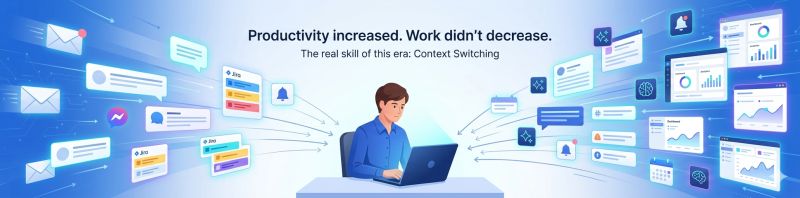
Will we work less in the AI era? I think we’ll end up doing more.
Since the Industrial Revolution, human labor has become steadily more efficient. Machines took over many tasks and made life easier. But efficiency has consistently increased speed, and speed has ultimately increased the volume of work.
1. Picture an office in the early 1990s. Before computers were everywhere, approvals ran on paper. Documents piled up on desks; work advanced only as fast as you could physically process it. The proverbial manager surrounded by stacks of paperwork was a familiar sight. The flow of work was bound to a physical pace.
2. The internet changed that in the 2000s. Electronic approvals arrived. Email and IM joined phone calls and conversations. Information traveled dramatically faster. The result was straightforward: each person had more work to process. Computers and the internet cut processing time and created the conditions for a higher volume of work.
3. Then came collaboration tools. Jira and similar tools gave us structured ways to manage work. At the same time, dozens of tickets can be created and assigned in a day, and new work keeps coming in. We now handle work from email, messaging apps and ticket queues. One of the biggest drains is context switching. The tools have multiplied, the channels have fragmented, and managing the work takes energy on top of doing it.
4. Perhaps that’s why I hear the same thing in one-on-ones with junior developers. “Work comes in from too many places at once.” A request in chat, a new ticket, an email, a meeting, then an unexpected issue. It’s the fragmentation of the flow as much as the sheer volume. Each switch uses more energy than you might expect.
5. I often say, “One of the things that distinguishes people at work today is how well they can switch contexts.” Going deep still matters. So does managing several things, changing contexts quickly and finding your focus again.
6. What about AI? It clearly raises productivity. We can write code, create documents, analyze things and organize ideas noticeably faster. But is it reducing our work—or enabling us to take on more?
7. We hear a lot about AI replacing jobs. What I see on the ground is a change in people’s roles. Developers used to spend much of their time hand-coding CRUD logic. Now they go deeper into design, define structures, set architectural direction and oversee AI-generated results. Even junior developers in our organization use tools like Claude Code as standard equipment. Interestingly, the amount we have to do hasn’t fallen. If anything it feels like more.
8. The world is changing so fast. New technologies, new services and new markets all move at once. We have to keep responding to keep up.
9. Here’s how I see it. AI definitely increases productivity. That doesn’t necessarily reduce the volume of work. We may be entering an era when AI allows us to do more and, as a result, we actually do more. One of the skills that will matter in that era? Being good at switching contexts.
#AI #일의미래 #생산성
All essays