Engineering notes · Published on LinkedIn
“Invisible developers” are multiplying inside companies. It’s given me a lot to think about.
Something keeps striking me in recent news and case studies. At companies that have adopted AI well, the common thread is employees starting to build their own tools. At SK Telecom, GS Caltex and LG Electronics, the model is shifting from developers building things for the business to people in the business building them directly.
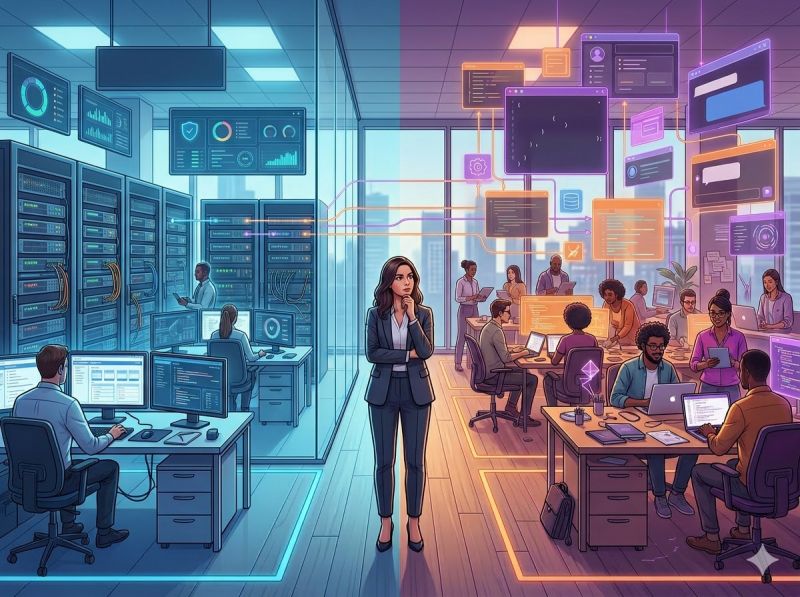
“Invisible developers” are multiplying inside companies. It’s given me a lot to think about.
Something keeps striking me in recent news and case studies. At companies that have adopted AI well, the common thread is employees starting to build their own tools. At SK Telecom, GS Caltex and LG Electronics, the model is shifting from developers building things for the business to people in the business building them directly.
I think that’s natural and points in the right direction. Developers, too, are quickly building scripts, agents and internal tools for their own work. As someone running a development organization, what I’m increasingly concerned about is what happens next. How long can all these tools remain personal?
Companies are balancing the urgency of AI transformation with data security. A few days ago I wrote about how this reminds me of BYOD and DIY twenty years ago. I hadn’t realized how casually people were already using the term BYOAI. It feels like the practice started in the field and only later got a name. Perhaps that’s why companies are bringing it into official environments.
The question remains. Individuals will build work tools at an ever faster pace. Some will be shared until they function as organizational standards. Others will be reused within a team. Some will be used briefly and disappear.
Can we treat them like Excel macros or personal templates? An AI-built tool can connect to internal data and influence business decisions. As soon as it’s reused, its impact spreads. The tool may look lightweight; its effects can be substantial.
Do we leave it with the individual or bring it into the organization’s management system? I think the boundary that’s changing is what we consider a system in the first place. Deciding where to draw that line is one of the hardest questions I face in running a development organization today.
#AI전환 #AX #개발조직
All essays